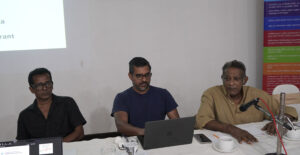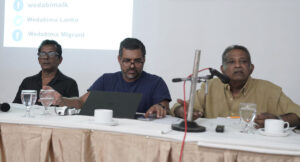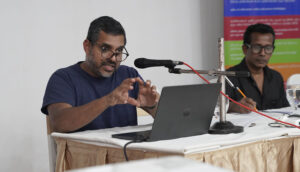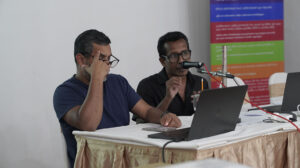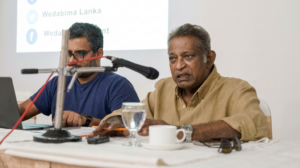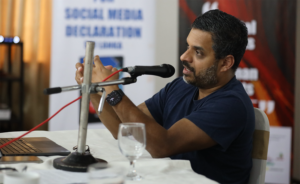
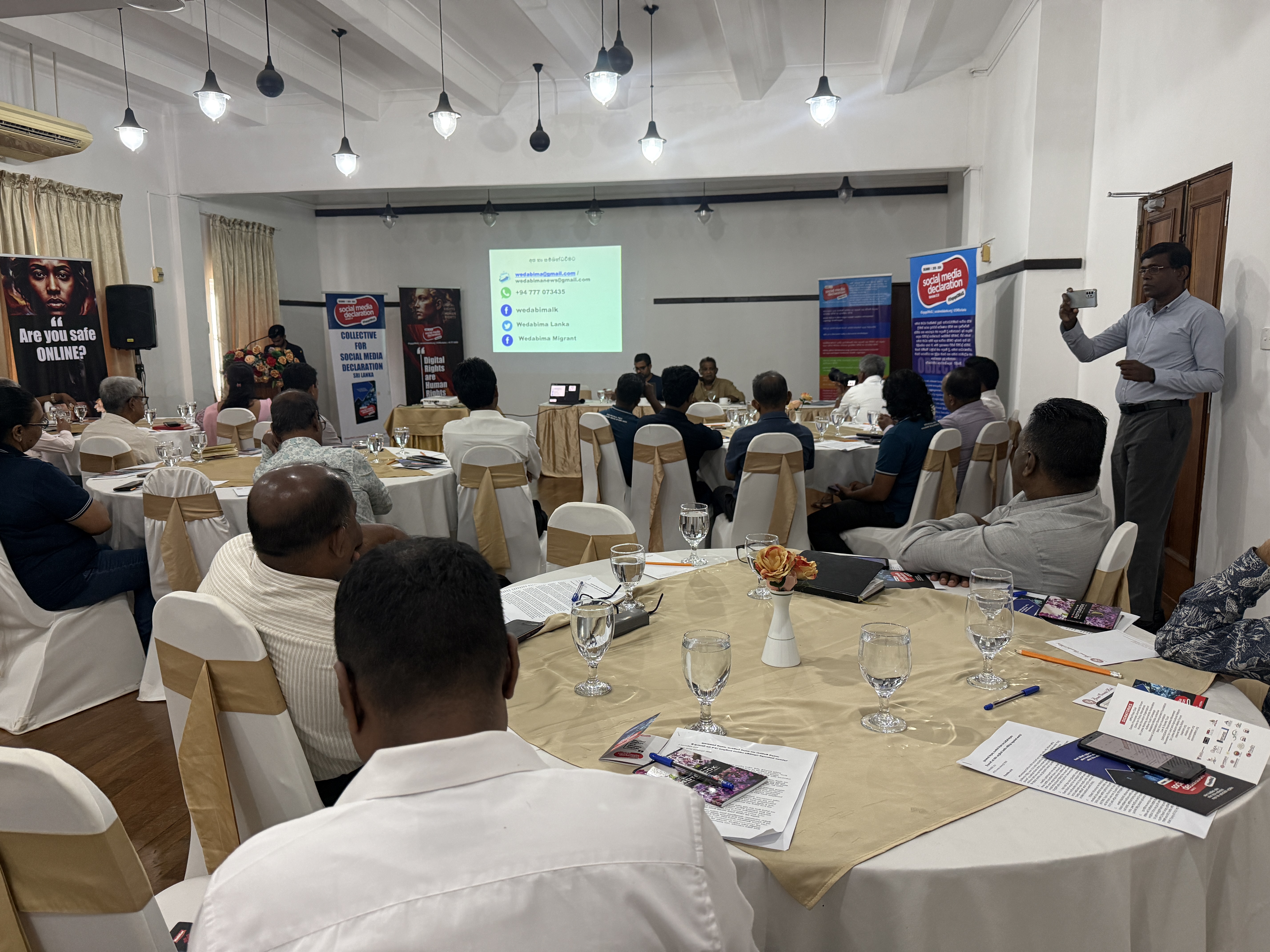

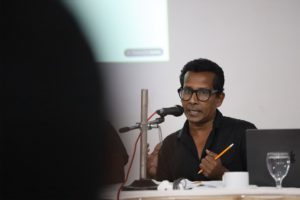
(Note) A special workshop examining how eight laws and bills proposed by the National People’s Power (NPP) government, including the ‘Protection of the State from Terrorism Bill’ (PSTA) and the ‘Prevention of Organized Crime Bill’ (POCB) – affect freedom of expression (FOE) and trade union activism was held on November 13 at the Grand Oriental Hotel (GOH) in Colombo.
Organized by ‘Wadabima’ Media Collective – a partner organization of the Collective for Social Media Declaration (CSMD) and the Centre for Policy Alternatives (CPA), the event saw the participation of nearly 35 trade union leaders and activists.
The keynote address was delivered by Dr. Paikiasothy Saravanamuttu, Executive Director of the Centre for Policy Alternatives, while Dr. Sanjana Hattotuwa made the introductory presentation on the topic: “What does the future hold for human rights, particularly trade union activism, in the context of analyzing the government’s laws and bills?”
Published below is the research-based analysis grounded in the ideas presented by Dr. Sanjana Hattotuwa.
(For the photo gallery of the event, scroll down to the bottom of the article.)
##





Critical issues
- Criticising an employer can be treated as a crime, since the Online Safety Act lets a presidentially appointed Commission decide what is a “false statement” and order content removed within 24 hours, before any court. Cargills Bank has already used it against people discussing its data breach.
- Picket lines and assembly are exposed under the revised PSTA Bill, which lets a police officer ban a meeting or procession before any Magistrate sees the order. A message warning colleagues of a police cordon could count as sharing “confidential information”, which carries up to 15 years.
- A union could be treated as an organised criminal group under a POC Bill that needs only 3 people acting in concert, reads “benefit” as any advantage including services, and infers membership from meetings, even virtual ones. The UN mandate holders warn that “a trade union” could be caught, and the Bill has no saving clause for lawful collective action.
- Secure messaging is at risk because police could direct encryption providers to unlock services, though with WhatsApp and Signal holding no keys, compliance means a backdoor or an exit. Signal, WhatsApp and Apple have each threatened or taken that step elsewhere. Sri Lanka has little leverage, so platform blocks, as in 2018 and 2019, are the likelier result.
- Members who report wrongdoing can be identified without a message being read, given that senior officers could obtain call and location data with no court order and that, as the UN notes, such metadata may reveal as much as content. The Anti-Corruption and Proceeds of Crime Acts already allow similar orders against people who are never suspected themselves.
- Knowing and telling become offences in a Bill that requires every person to report suspected serious crime to police despite any duty of secrecy, on pain of 7 years’ imprisonment, with no defence for professional confidences. A separate tipping-off offence could reach an officer who warns members that police are asking about them.
- Membership lists and data have thin protection, with the draft NGO law forcing groups of 5 or more to register and align with government policy and the PDPA not treating trade union membership as a special category. In July 1983, voter lists compiled for another purpose were used to find Tamil homes and businesses.
- Detention and courts are weakened by a POC Bill that allows detention orders of up to 1 year, issued by a ministry Secretary, with the Magistrate directed to give effect, and that makes confessions to police admissible. Reporting court proceedings without permission is also an offence, so a union may be unable to tell members what is happening to a detained colleague.
- GSP+ and members’ jobs are linked to these rights, because the OSA is a statute in force, the EU wants it amended or repealed, and reapplication falls due by the end of 2028. Losing GSP+ would hit export workers first, so protecting union rights and protecting members’ jobs are the same commitments.
- The burden is uneven, with a large Colombo federation able to hire lawyers while a plantation or free trade zone union would likely have none, and the time is short, since the POC Bill can be challenged in the Supreme Court only within 14 days of reaching Parliament’s Order Paper, and all these powers end at the Executive Presidency, which the government was elected to abolish and has not.
A censorious constellation
Since 2023, Sri Lanka has enacted, gazetted or circulated at least 8 laws and draft laws on what citizens and organisations may say, publish, fund and organise. The Online Safety Act (OSA), the Anti-Corruption Act and the Proceeds of Crime Act are already in force, and a fourth, the Personal Data Protection Act (PDPA), commences only in part on 1 January 2027, while the remaining 4 are Bills or drafts, namely the Protection of the State from Terrorism (PSTA) Bill, the Prevention of Organised Crimes (POC) Bill gazetted on 2 October, the draft NGO Registration and Supervision Bill and the 2023 draft Cybersecurity Bill. I counted 7 in my August study, A perfect storm[1], and the POC Bill is the eighth. Unions hold members’ money, records and private messages, so they have a direct stake in how these laws combine against expression, association and assembly.
Interaction design
Each law is critiqued separately, so attention follows the loudest clause while the scaffolding goes up behind it. I have argued that silencing an organisation needs no single perfect authoritarian law, only a map of who the organisation is and who belongs to it, a means of contesting what it says in public, a route into its money, communications and devices, and institutions able to pass what one learns to another. The NGO draft and the digital identity system supply the map, the OSA reaches expression, the Anti-Corruption and Proceeds of Crime Acts reach bank, phone and device data on ex parte orders (made without the person affected being heard), and the PSTA and POC Bills add detention and decryption. I call this interaction design, in which a power refused a home in one law turns up in the next.
Speech, streets and suspicion
On speech, the OSA makes a “false statement” that threatens national security, public health or public order an offence carrying up to 5 years in prison, and a Commission appointed by the President may order content removed within 24 hours. That Commission decides what is false, before any court, so a union’s account of a dispute can be called false by whoever disagrees with it. The Act is not the state’s alone, since in April 2025 Cargills Bank used it against websites and social media accounts discussing its data breach, and an employer in dispute with a union could take the same road.
Assembly fares no better under the revised PSTA Bill, which lets the officer in charge of a police station, before any Magistrate sees it, order people not to gather or hold a meeting, rally or procession (section 51), and makes disobeying it an offence. Sharing “confidential information” about police or armed forces conduct carries up to 15 years where the sharer has reasonable grounds to believe it will be used to commit an offence under the Act (section 8), so a message warning colleagues of a police cordon at a picket line could fall within it on a literal reading.
The POC Bill brings the same risk closer to the picket line, since it defines an organised criminal group as 3 or more people acting in concert, aiming at a “financial or other material benefit” that section 66 stretches to any advantage “including services”, and it infers membership from “physical or virtual meetings with known members”. Its First Schedule includes obstructing a public servant, wrongful confinement and using criminal force to deter a public servant, which a joint letter of 30 October from 5 UN human rights mandate holders says are commonly charged in connection with demonstrations, strikes and land disputes. The letter warns that the Bill could treat “a trade union, a student organisation, a community defending its land, or an association of protesters” as an organised criminal group, and asks what exemption will protect trade unions. Nobody should claim that the Bill targets unions, but a police officer draws the line at the stage of suspicion.
The draft NGO law would require any group of 5 or more persons formed for non-profit purposes to register and align with government policy, and my study notes that union advocacy beyond a narrow statutory core could be drawn in.
Keys, calls and confidences
Union organising now runs on WhatsApp and Signal, and both rely on end-to-end encryption (E2EE), where only the sender and recipient hold the keys. Section 45 of the POC Bill lets a Superintendent of Police, on a Magistrate’s order, direct “any person who provides locking or encryption services” to unlock a service and hand over what it holds, which is the power that section 55 of the first PSTA draft contained, that the revised PSTA dropped and that the POC Bill restored within a fortnight. A UN letter[2] calls its threshold too low and its purposes excessively wide, cites the Special Rapporteur on freedom of expression for the principles that decryption orders must be case-specific, judicially authorised and proportionate and that providers should not be compelled to weaken encryption for all users, and reads section 45(1)(a) as capable of requiring exactly that. It also objects to section 44(4), which lets a Deputy Inspector General obtain subscriber, call and location data without a court order, since such metadata may reveal as much as content.
An E2EE service holds no keys, so an order under section 45 either cannot be obeyed or demands a backdoor that weakens the product for every user. Signal’s president said it would “absolutely, 100% walk” from the UK over its Online Safety Act[3], and in May 2026 Signal told a Canadian parliamentary committee, “If we are ever forced to choose between betraying the people who rely on us and leaving a market, we will leave.”[4] WhatsApp, which Meta owns, told the Delhi High Court in 2024 that if told to break encryption “WhatsApp goes”, and Apple, the one company whose exit was real rather than threatened, withdrew encrypted iCloud backups from UK users[5] in 2025 after a reported demand for access. Sri Lanka has far less leverage than any of those markets, so the likelier outcome is pressure on the companies and, failing that, platform blocks, as in 2018 and 2019, which would leave a union without its branch groups and members without a secure channel.
Encryption protects less than people assume, since it covers neither backups, handsets nor the person at the other end, and section 65 requires that person to tell police what they know “notwithstanding any obligation of secrecy”, on pain of 7 years’ imprisonment. The UN letter notes that the revised PSTA allows a reasonable-excuse defence for professionally secret information whereas section 65 has none, and that the tipping-off offence in section 56 could reach a journalist or relative who discloses an investigation, which on my reading may extend to a union officer warning members. The PDPA offers little refuge, since the Bill neither mentions nor displaces it.
The GSP+ test
GSP+ is the European Union’s trade preference scheme, which gives Sri Lankan exporters duty-free access in return for effective implementation of 27 international conventions, among them the International Covenant on Civil and Political Rights (ICCPR), whose Article 22 protects association “including the right to form and join trade unions”, and ILO conventions 87 and 98 on freedom of association and collective bargaining. Current beneficiaries must reapply, with action plans, by 31 December 2028[6]. The Sri Lanka Brief’s account of the Commission’s 2026 assessment says the EU wants the OSA amended or repealed and the Prevention of Terrorism Act replaced.
My argument is that the OSA settles the matter on its own, since a draft can be promised away and a statute in force cannot. Its first prosecution concluded in April 2026, the Human Rights Commission has urged a moratorium, and the UN High Commissioner for Human Rights, 3 Special Rapporteurs and the EU Election Observation Mission have each independently said it should be repealed, not repaired. The PSTA, POC and NGO texts widen the gap, so I do not see how an honest 2028 action plan can be written around them. The cost would fall on export workers, not ministers, so the commitments that protect union rights also protect members’ jobs.
First principles
Article 14(1) of the Constitution guarantees speech, peaceful assembly, association and the freedom to form and join a trade union, and any law limiting them must be clear, serve a legitimate aim, be necessary and proportionate, and be decided by an independent court rather than an official answerable to the executive, and while the aims here are legitimate, the means fail every one of those tests. In a letter made public on 21 October, the Human Rights Commission of Sri Lanka told the Justice Minister that the POC Bill is “wholly incompatible” with the fundamental rights chapter and “potentially more draconian” than the Prevention of Terrorism Act. The Bill gives a ministry Secretary detention orders of up to 2 months at a time and 1 year in all, with a Magistrate directed to give effect, and disapplies the rules barring confessions to the police, so courts sit behind the intrusion instead of in front of it. A large Colombo federation can hire lawyers, while a small plantation or free trade zone union would likely have none.
Time, text and tactics
With GSP+ reapplication due by the end of 2028 and the next elections not due until 2029, the government will answer to the European Commission on these laws before it answers to voters, which is why the timetable matters as much as the text. The POC Bill is more urgent, since the UN letter notes that it can be challenged in the Supreme Court only within 14 days of being placed on Parliament’s Order Paper. Unions can press for repeal of the OSA rather than its repair, for express protection of industrial action, assembly, union communications and union records in every one of these texts, for judicial orders naming the device, account and period before any search or decryption, with no power to make providers weaken encryption, and for the missing parts of the PDPA to be in force before any new database connects. Each of these instruments ends at the command of the Executive Presidency, which the government was elected to abolish and has not. (More Information: https://sanjanah.wordpress.com/2026/11/13/expression-association-and-assembly-how-sri-lankas-new-laws-threaten-trade-unions/)
[1] A perfect storm: Digitalisation, new laws, draft bills, and threats to civic space in Sri Lanka, https://sanjanah.wordpress.com/2026/08/14/a-perfect-storm-digitalisation-new-laws-draft-bills-and-threats-to-civic-space-in-sri-lanka/
[2] Penned by Mandates of the Special Rapporteur on torture and other cruel, inhuman or degrading treatment
or punishment; the Working Group on Arbitrary Detention; the Working Group on Enforced or Involuntary Disappearances; the Special Rapporteur on extrajudicial, summary or arbitrary executions and the Special Rapporteur on violence against women and girls, its causes and consequences, 30 October 2026.
[3] Signal would ‘walk’ from UK if Online Safety Bill undermined encryption, https://www.bbc.com/news/technology-64584001
[4] Signal, DuckDuckGo weighing exit from Canada over lawful access bill, https://canadianprivacy.ca/archives/12347
[5] Apple pulls data protection tool after UK government security row, https://www.bbc.com/news/articles/cgj54eq4vejo
[6] EU Trade Reset Puts Sri Lanka’s GSP+ Privileges Under a Sharper Lens, https://srilankabrief.org/eu-trade-reset-puts-sri-lankas-gsp-privileges-under-a-sharper-lens/
(Look out for the Sinhala version of this through vikalpa.org)